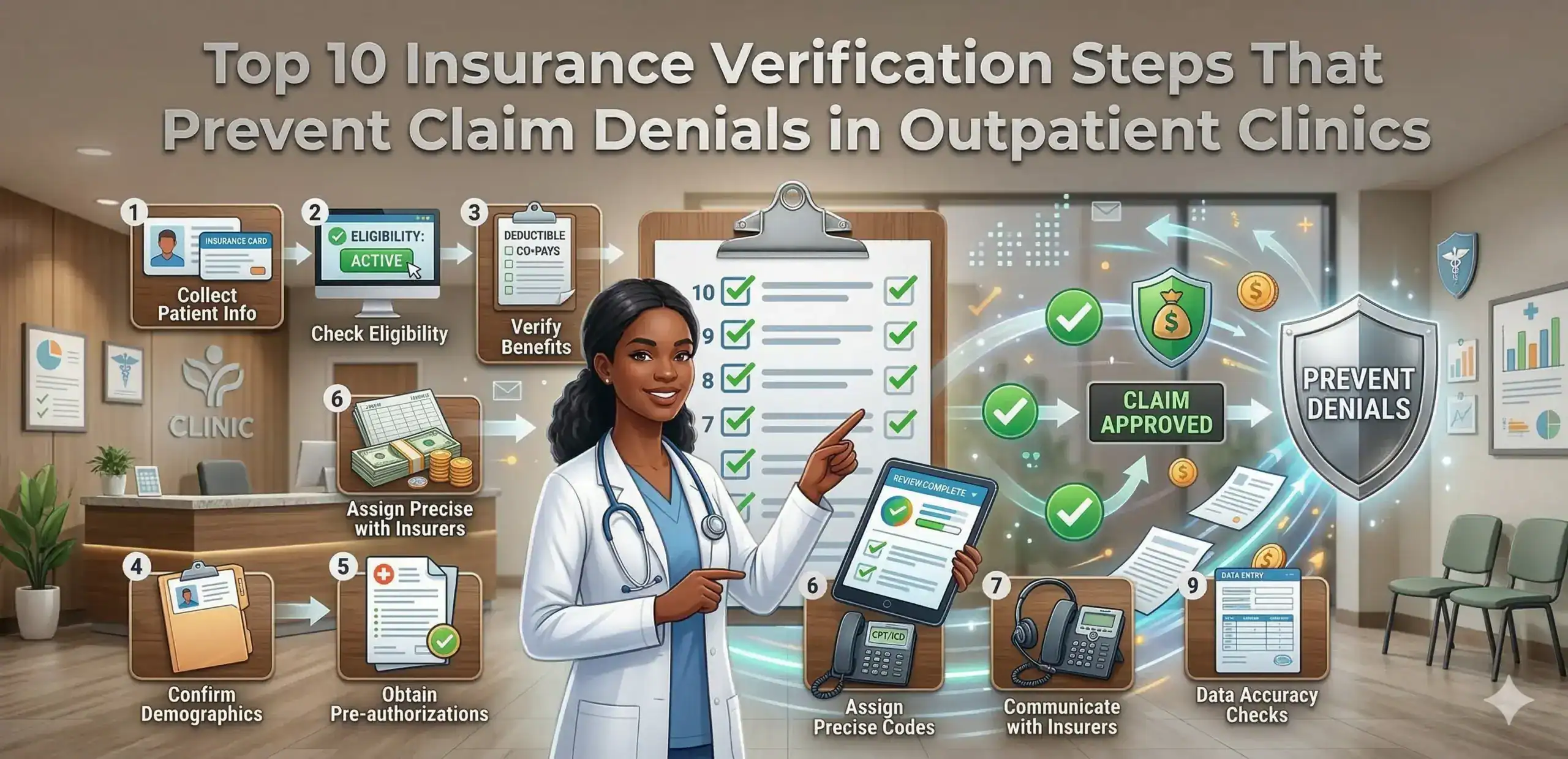
Top 10 Insurance Verification Steps That Prevent Claim Denials in Outpatient Clinics
One of the most important administrative functions in the delivery of outpatient healthcare services is insurance verification. If the insurance information is verified before the patient’s service, the risk of denial of payments for the services provided is significantly reduced.
Insurance information that is incomplete, outdated, or misunderstood is one of the main reasons for the denial of payments. Outpatient clinics have numerous appointments every day, which makes insurance verification accuracy extremely important for the financial stability of the clinics.
Proper insurance verification ensures that the patient’s eligibility, insurance benefits, and authorization requirements are clearly understood before the delivery of services. If the insurance verification process is functioning correctly, the patient and the provider both reap the benefits. Proper insurance verification turns the medical billing process into a positive strategy.
Step 1 – Collect Accurate Patient Insurance Information

The first step in the prevention of claim denials is the collection of insurance information from the patient. The insurance provider name, the patient’s ID, group number, policyholder’s name, and the date of birth need to be collected from the patient.
The clinic also needs to check whether the patient is the policyholder or a dependent of the policyholder. Any small mistakes in the data entry field will lead to claim denials. The patient needs to provide the insurance card at the time of scheduling the appointment, and this information needs to be collected accurately at the front desk before the visit takes place.
If the patient has secondary insurance coverage, this information also needs to be collected accurately. The collection of data is the foundation of the insurance verification process.
Step 2 – Confirm Patient Eligibility Before the Appointment
Eligibility verification is used to verify that the patient’s insurance policy is active at the time of service. In fact, it is often the reason why patients are denied services, as the insurance policy may have lapsed or changed. It is therefore important for the clinic to verify the patient’s insurance at least 24 to 48 hours before the visit is scheduled to occur.
There are electronic tools that can assist the staff in the clinic with the verification of the patient’s insurance. This will help the clinic to know the status of the patient’s insurance, including the start date of the insurance policy. This will help the clinic to resolve the issue before the patient’s arrival.
Step 3 – Verify Patient Benefits and Coverage Limits
However, the fact that the patient is eligible for the service does not mean that the service will be included in the insurance benefits. The clinic must check the benefits of the patient to find out which services are included in the insurance plan.
There may be certain limitations for the service, tests, and visits to specialists. This information will allow the clinic to avoid submitting claims for services that are not reimbursable. The deductible amounts, copays, and coinsurance percentages must be verified.
This information will allow the clinic to explain the out-of-pocket expenses to the patient before the service is rendered. This will ensure the satisfaction of the patient. Verifying the benefits of the patient will allow the clinic to provide the service according to the guidelines for the insurance coverage.
Step 4 – Check Prior Authorization Requirements
Many outpatient procedures also involve a requirement for prior authorization with the insurance provider. Without this, the procedure will most likely be denied, irrespective of the medical necessity. It is essential for the clinics to check if the procedure needs any prior authorization before the patient is scheduled.
In most cases, the requirement is for procedures like imaging, specialized procedures, and sometimes treatment. It is essential to seek approval electronically or contact the payer to obtain approval, which is necessary for documentation. In some instances, the clinics may have to reschedule the patient’s appointment if the authorization is not obtained in time. Prior authorization is a vital process in avoiding one of the most common and preventable denials.
Step 5 – Verify Referral Requirements
Some plans have rules requiring patients to get a referral from their primary care doctor before seeing other specialists. If they do not have a referral, their claim might be denied. The clinics should verify whether they have a referral by checking whether their plan requires it and whether it has already been issued.
This is important to prevent denial of the claim by ensuring that the patient’s visit is covered by their insurance provider. This is especially important for specialty outpatient clinics and diagnostic services.
Step 6 – Confirm Coverage for the Specific Procedure
Insurance plans provide coverage for the services only when certain conditions are met, and hence the need for procedure verification during the insurance verification process. The clinic needs to verify whether the exact treatment, test, or procedure that is scheduled for the patient is covered under the insurance plan.
This is usually done by comparing the CPT codes for the procedure with the insurance plan guidelines provided for the patient. Insurance plans provide coverage for the procedures only when certain conditions are met or when the procedures are conducted in a certain setting. The clinic will avoid any problems where the procedures were conducted, only for the insurance company to deny the procedures later.
Step 7 – Identify Patient Financial Responsibility
The calculation of the patient’s financial responsibility is an essential step in avoiding billing misunderstandings and increasing revenue cycle success. The verification of insurance should also include the calculation of the co-payments, deductible balances, and coinsurance percentage for the visit.
Many ambulatory services use eligibility tools to calculate the patient’s portion of the visit prior to rendering services. Educating the patient on this information will also help them financially prepare for the visit.
Patients are more likely to make their payments when they understand their portion of the visit. Clinics that require co-payments or partial balances during the visit will reduce the likelihood of non-payment for the visit. This will also increase the level of trust with the patient.
Step 8 – Reverify Insurance on the Day of Service
The information regarding insurance coverage is dynamic and can be updated frequently. There might be changes to the policies, changes in employment status, and other factors that might affect the accuracy of the information.
Therefore, it is important to recheck the eligibility on the day of service. This is because, even though verification is done a few days before, there is always a chance that the status might have been updated by the time the patient comes for their appointment.
This quick verification will ensure that the coverage is active and that all other information is still accurate. This might seem like a redundant activity, but it is important for ensuring that there is no last-minute surprise and that all issues can be addressed at the earliest sign of coverage problems.
Step 9 – Maintain Accurate Documentation

Good documentation is very important to support the whole insurance verification process. The clinics must document the entire process of insurance verification in the patient’s account.
For example, the clinics should document the insurance eligibility, authorization number, referral, etc. Such documentation becomes extremely useful if the insurance provider disputes the claim at a later date. Documentation also helps the billing department to ensure that the insurance verification process is complete before the actual claim is submitted.
Most electronic record systems have the option for the staff to document the insurance verification notes in the patient’s profile, making the information readily available if needed. Proper documentation also helps the clinics in case of an audit or investigation.
Step 10 – Train Staff and Standardize Verification Procedures
The insurance verification process is more efficient when every staff member is aware of the procedure. This is why it is highly recommended that clinics develop a standardized process that guides their staff members in the entire insurance verification process. This way, the staff will always know the procedure to use in the process.
This will help in the minimization of errors in the insurance verification process. In addition, training the staff members will help them to stay updated with the latest changes in the insurance policies. This way, the clinics will not only have a better revenue cycle but will also help in the minimization of denials. This will help in the improvement of the entire insurance verification process.
The Financial Impact of Strong Verification Processes
Insurance verification has a direct effect on the financial well-being of an outpatient clinic. When the verification process is done properly, the rate of denied claims is greatly reduced. This eliminates the lengthy process of appeals for denied claims and the subsequent delays in payments.
Outpatient clinics benefit from the improved cash flow since the claims are processed the first time. This saves the administrative staff time, which would be spent correcting the claims, and more time is devoted to the operations of the patient care side of the clinic.
Over time, the verification process improves the rate of clean claims and the overall relationship with the insurance payers. Outpatient clinics that take the verification process seriously are better off in terms of the revenue cycle and the overall disruptions in their financial status from denied claims and delayed payments.
Building a Culture of Claim Denial Prevention

It is, of course, more involved than simply following a list of procedures, and it is also more involved than creating a culture of verification accuracy. Every staff person involved in scheduling, registration, and billing processes plays a role in the verification process.
Clinics with strong cultures of verification accuracy and attention to communication create processes that ensure issues are identified and addressed before services are delivered. This is key to establishing strong denial prevention strategies for an outpatient clinic.
By incorporating verification as a standard process for all patients, administrative processes run more smoothly, and the patient benefits as well, as they will be provided with more accurate and timely information about their costs and billing processes.
Conclusion
Effective insurance verification is perhaps the surest way to ensure that outpatient clinics avoid denied claims while at the same time keeping their revenue cycles healthy. This is because, by following a series of steps in the process of verifying a patient’s information, eligibility, benefits, prior authorizations, and documenting the results, the clinics ensure that they do not make any billing mistakes before attending to the patients.
This way, when the process is a regular part of the entire process, it becomes easier to communicate with the patients about their financial responsibilities, thus reducing any potential problems. With this, it becomes evident that effective insurance verification is essential in keeping the revenue cycles of the clinics healthy while at the same time ensuring that the patients get the necessary attention without any financial complications.
FAQs
Why is it crucial for outpatient clinics to verify insurance?
Insurance verification helps avoid claim denials and billing delays by confirming patient coverage prior to services being rendered.
When is it appropriate to confirm insurance eligibility?
Both at the time of scheduling and on the day of the appointment, eligibility should be verified.
What leads to the majority of outpatient claim rejections?
Inactive coverage, missing authorizations, problems with referrals, and false patient data are common causes.
How can clinics lower the number of errors in insurance verification?
Verification accuracy is increased by the use of computerized eligibility tools, staff training, and consistent workflows.
Is it always necessary to confirm prior authorization?
Yes. The insurance claim may be rejected if a service required prior authorization and it is not acquired.